
By Mark R. Hanson
Do Christians become ghosts when they die?
According to one old-fashioned Baptist ghost story in a Canadian Baptist journal entry, Annie Slosson says yes, she’s seen them herself. Her tale appears in the August 1914 issue.1

Mrs. Slosson recalls that day. She saw first a man who reminded her of her neighbour, Job Waters, who died two years previously: “Job was such an easy-going kind of a man, never upset or ruffled up, and this one looks a mite troubled like and sorry.” This encounter did not tune Mrs. Slosson into the spectral event happening around her. Soon she met a lady with a loose scarf, who hitched her shoulder to keep it on. Mrs. Slosson “almost spoke out loud then for that was just like Andrew’s Little’s Wife, the Cap’n’s daughter-in law. She was a dreadfully nervous woman and had a way of twitching her shoulders with her head a mite to one side.” Only “poor Sarah little had been dead six months or more.” Annie would see many ghosts return to her town that day, including Emma Mary, Amos, Hannah Brown, and Len Walker. The whole town seemed filled with the dead.
But Mrs. Slosson claims she was not the only person to see these apparitions. Another resident, Mr. Brewster, also saw the same ghosts, but he was not bothered by them. Out of all these ghosts one brought great turmoil to Mrs. Slosson. Her dead husband had also returned and roamed around her home. She writes “I can’t tell you how I felt; there’s no words could do it if I wanted to. I was shaking and terribly weak; but I contrived to steal along, step at a time, till I got close up to him and I could see his face.” Seeing him caused her to cry out in remorse: “O Abram, Abram, don’t worry over that. I never minded after the first minute, and I didn’t feel it no great even then. You wa’n’t a bit well; you was coming down with that last sickness you gave up to only next day, and your nerves was all on edge. ‘Twas only words, anyway, and they went out at my mind the next minute; and there’d been forty years o’ the other kind o’words.”
Slosson claims this event left her sick for a long while. Sometime later, upon reflection Mrs. Slosson realized “every one that I saw, good folks, Christians as far as I knew.”
So, do Christians come back as ghosts? Well, the thing about ghost stories is they are often more fiction than fact, and Annie Slosson’s story is fiction through and through.

You may not have recognized her immediately, but Annie Slosson is an active writer within the American literary movement called “local color.” (she was also a professional entomologist). This style of fiction portrays the aesthetics of local life: geography, dialects, and cultural elements, but it largely ignores plot.2
This story in the Canadian Baptist is called “Old Home Day.” It draws from a local New England festival of the same name. Old Home Day is a homecoming festival where residents who once lived in a town return to visit and reconnect. Slosson’s story iterates on that tradition by having ghosts return home for a day to celebrate that festival.
It turns out humans like paranormal stories. They were as popular a hundred years ago as they are today. These tales gain strength from their “un-fiction” presentation, which is an immersive style of story-telling, where the story does its best to present itself as real. Recent decades have seen the rise of internet ARGs (Alternate Reality Games) which blur the lines of fact and fiction, for example Marble Hornets was one popular ARG that spawned the “Slenderman” phenomenon.
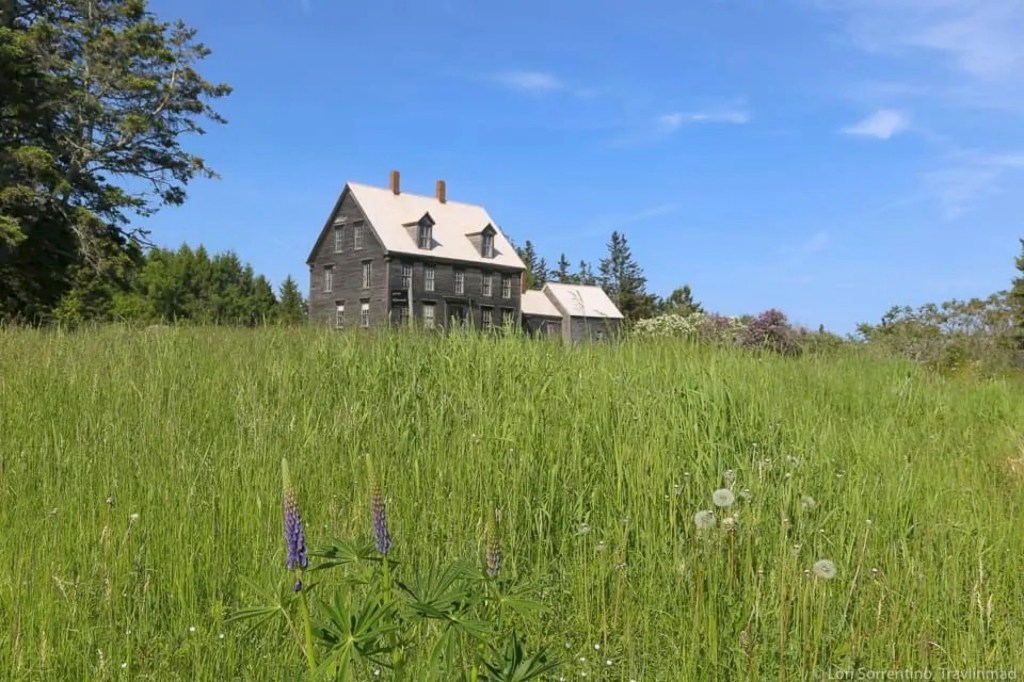
But what is this story doing in the Canadian Baptist? Surely Baptists do not have a long history of good old fashion ghost stories?
Well, humans have a long history of using fiction as a handmaiden for truth. The ancient geographer Strabo defended Homer’s use of fiction to adorn and embellish his subject yet as one who “relates nothing but facts.”3 Modern authors like CS Lewis or JRR Tolkien have received a lot of fanfare within the Evangelical world. Fiction helps embed truth and ideas within a story and thus makes them more accessible to the ordinary person. Baptists value preaching the gospel, and yet Jesus himself used parables to preach to his generation. Fictional tales is one way we can speak to ordinary people today about the love of God, and yes even ghost stories can be redeemed in the Kingdom of God.
* * *
Mark R. Hanson holds a PhD in Christian Theology from McMaster Divinity College in Hamilton, ON. He is a part-time Lecturer of Religious Studies at Crandall University in Moncton, NB.
Endnotes
- All references to this article in the Canadian Baptist are from Annie Trumbull Slosson, “Old Home Day,” Canadian Baptist, 6 August 1914, 14–15. ↩︎
- Read more on local colour here: https://public.wsu.edu/~campbelld/amlit/lcolor.html ↩︎
- Strabo, Geography, 1.2.9. ↩︎
**The views of this Blog represent those of the author, and not necessarily the CBHS.**
 Canadian Baptist Historical Society
Leave a comment